
Death Exposure Management™ Talk & Workshops
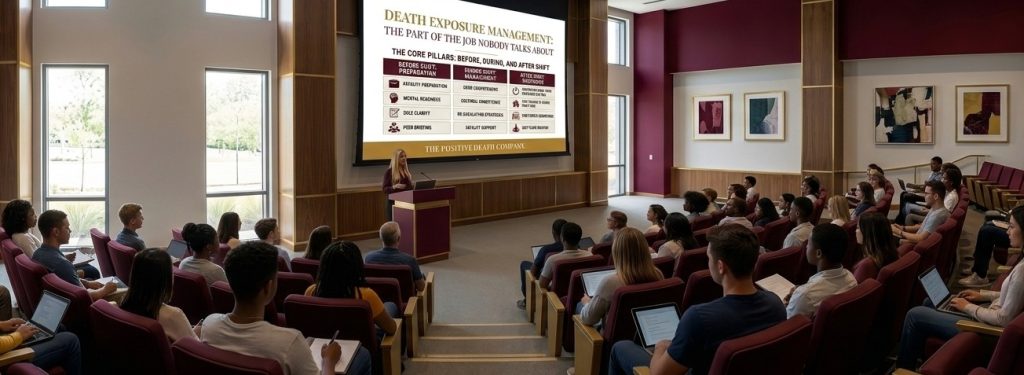
Filling a Critical Gap in UK Professional Training
Death Exposure Management™ fills this vital void. It is a proactive, operational framework designed to prepare frontline personnel for direct contact with mortality, severe trauma, and acute human grief before they step out onto the job—moving beyond reactive post-incident debriefs and building true, long-term operational resilience.
Who This Talk Is For
- Blue Light & Emergency Services: Police officers, paramedics, call handlers, and fire and rescue personnel
- Healthcare & Acute Care: NHS frontline staff, emergency department teams, intensive care personnel, and nursing cohorts.
- Social Care & Community Services: Social workers, housing crisis officers, and frontline support teams.
- Higher Education & Professional Training: Academic institutions preparing final-year undergraduate and postgraduate cohorts for high-exposure careers
- Corporate & Operational Leadership: Sector managers, HR leads, and occupational health teams responsible for staff well-being in high-risk environments.
Why Choose Us?
Key Aims & Objectives
1. Build Psychological Readiness (Pre-Exposure)
- Demystify the Physical Reality: Address the unvarnished sensory impact of death—the sights, smells, and visceral realities—that standard procedural training completely ignores.
- In-the-Moment Regulation: Teach tactical physiological tools (such as cognitive grounding and regulated breathing) to manage fight-or-flight arousal before stepping onto a scene.
2. Safeguard Operational Functionality (Peri-Exposure)
- Master Professional Compartmentalisation: Equip staff to remain compassionate, objective, and fully functional during acute crises or death notifications without freezing or absorbing room trauma.
- Manage Professional Boundaries: Establish clear psychological lines between the reality of the scene and the professional’s personal life.
3. Prevent Cumulative Trauma & Burnout (Post-Exposure)
- Differentiate Grief from Trauma: Help teams recognise the difference between normal emotional responses to loss and clinical PTSD indicators.
- Establish Transition Rituals: Provide concrete de-escalation tools to cleanly mark the end of an exposure event before moving to the next call or heading home.
- Transform Team Culture: Normalise open, non-judgmental peer debriefs to dismantle “toxic resilience” and dark humour coping mechanisms, replacing them with genuine team literacy around loss.
Keynote & Guest Speaking
Includes a 60-minute signature talk, tailored delivery and audience Q&A.
Note: Academic, public sector, and corporate rates vary depending on cohort size and requirements. Half-day and full-day Operational Workshops are also available upon request. Travel expenses are calculated separately.
Workshops
1. Bereavement, Grief, and Wellbeing in the Workplace
- Understanding the practical, physical, and emotional impact of grief on work performance and focus.
- What to say (and what to avoid) when a colleague returns to work after a loss.
- How managers can balance empathy with practical operational support without micromanaging.
- Building a compassionate, supportive workplace culture where people feel safe coming back to work.
2. Grief and Wellbeing Support Hubs
- Group Hubs: A warm, facilitated group space to share experiences, learn practical coping strategies, and normalise grief in a safe, non-judgmental environment.
- Confidential 1:1 Sessions: Private 30-to-45-minute virtual or on-site support slots for individuals needing focused, personal grief guidance and coping frameworks.
- Designed to fit seamlessly into employee assistance programmes (EAP) and ongoing wellbeing strategies.
3.Death Exposure Management™
in the Workplace
- Pre-Exposure Grounding: Tactical physiological tools to manage fight-or-flight reactions before stepping onto a scene.
- Boundary Control: Healthy compartmentalisation techniques to stay fully functional during a crisis without absorbing the shock long-term.
- Decompression Rituals: Practical end-of-shift habits to leave the job at work and prevent cumulative grief from turning into burnout or trauma.
- Replacing Toxic Resilience: Moving away from dark humour and silence toward open, supportive peer debriefs.
Ready to bring these sessions to your team?
After Working With Us: What Often Changes
Working together is not about removing grief or avoiding the reality of loss. It’s about changing your relationship with death, anxiety, and emotional overwhelm so that you, your workforce, or your office can operate with steadiness, clarity, and true resilience. When we strip away the fear, the heavy lifting becomes humanly manageable.
The emotional, cultural, and psychological shifts experienced include:
Less fear around death conversations
- Death ceases to be a taboo that causes immediate emotional shutdown, panic, or avoidance.
- Conversations that once felt impossible or awkward begin to feel entirely natural, human, and grounded, whether in the boardroom, the classroom, or at home.
Greater stability through grief and crisis
- The intensity of loss does not disappear, but the emotional waves become less destabilising.
- Individuals and teams develop a greater capacity to stay present with reality, maintaining structural stability without pulling the organisation or themselves into emotional collapse.
The ability to speak about mortality without avoidance
- Whether navigating a corporate bereavement, terminal illness, or personal legacy planning, you gain the ability to address the situation with total grounding. Instead of shutting down, managers, staff, and individuals learn to engage with the subject while staying completely regulated under pressure.
The Impact to Frontline Staff and Post Graduates
Following the Death Exposure Management talk, post-graduates and frontline staff transition from anxiety to grounded confidence, equipped with practical tools to process occupational trauma and prevent burnout. They leave with the language needed to break the culture of silence on their units, initiating open debriefs with their teams rather than carrying loss alone. Ultimately, they step onto the frontlines with the emotional resilience required to protect their personal well-being while sustaining a compassionate, long-term career.
A calmer relationship with uncertainty
Over time, the collective anxiety around the unknown dissipates. Instead of being at war with the realities of mortality, individuals, families and teams learn how to hold space for grief alongside daily life and operational demands, rather than being consumed by it.
My Final Wishes Digital Programme: Step-by-Step Online Workshop

Aims and Benefits
- Save Money: Access expert-led guidance at a fraction of the cost of one-to-one home consultations.
- Relieve the Burden on Family: Clear away the guesswork for your relatives, ensuring they know exactly what you wanted when the time comes.
- Work in a Safe, Small Group: Limited to a maximum of 6 participants per cohort to ensure a personal, supportive, and unhurried space.
- Build Your Personal Life Folder: Receive practical digital workbooks to fill in and store alongside your official Will and legal documents.
How It Works: The 3-Session Breakdown
Session 1: Practical Foundations & Digital Legacy
- Locating key documentation, financial accounts, and subscription lists.
- Understanding the UK probate context and what executors need on day one.
- Managing your digital footprint, social media accounts, and online assets.
- Aligning your plans with your Will and Lasting Power of Attorney (LPA).
Session 2: Care Preferences & Funeral Choices
- Funeral options: from traditional services and direct cremations to green burials and home deaths.
- Practical considerations around costs, venues, music, and personal touches.
Session 3: Personal Legacy & Ethical Wills
- Writing an “Ethical Will” to share your values, life lessons, and hopes for the future.
- Structuring personal letters, video messages, or memory caches for loved ones.
- Recording specific personal belongings and who should receive them.
Programme Details
| Feature | Details |
| Format | 3 x Live Zoom Sessions (60–75 mins per session) |
| Group Size | Strictly capped at 6 participants per cohort |
| Deliverables | PDF templates emailed prior to each session to collate your Master Folder |
| Investment | £149 per person (Compared to £450+ for 1:1 home visits) |